
Springfield Township Neighbor Records
A neighbor question starts with land records, not a list of people. The County's assessment search and GIS map can connect an address to a parcel identifier and show the parcels around it. Recorder Cloud Search can then identify parties and documents tied to a PIN or instrument. Those sources are useful for property history, yet they do not establish who occupies a home. Pennsylvania's controlled election materials and local community contacts also serve limited purposes. No verified public Springfield Township HOA roster, block-watch roster, or parcel-to-household directory was located.
| Block source | What it can show near an address | Access and boundary |
|---|---|---|
| Assessment address search | Address results and parcel identifiers on a street | Address and wildcard route, not surname search |
| County GIS parcel map | Parcel polygons, PIN, map adjacency, and measurements | Spatial tools only, no household fields |
| Recorder Cloud Search | Recorded parties and documents tied to a parcel or instrument | Land history, not occupancy history |
| Election street list | Statutorily controlled street-address material | Election-purpose request with safeguards |
| Township community contacts | Ways to contact civic and service groups | No member or address roster implied |
The official Delaware County mapping portal and its parcel layer are the correct first tools for Springfield Township neighbors because they show land geometry. The tax system's address result can supply a PIN, but the County removed owner-name searching. A corner lot, common space, access lane, or condominium arrangement can make the parcel beside a point on the map different from the home a person considers next door.
Note: A parcel polygon identifies land adjacency, not a current resident, tenant, utility customer, delivery recipient, or every household member.
Springfield Township Neighbor Boundaries
The County GIS interface has tools that make a bounded block review possible: zoom, pan, identify, point and freehand selection, box, polygon, and line selection, plus corresponding unselect controls. It also provides distance and area measurement, printing or download, layer controls, a selection manager, and Parcel-ID search. Buffer Select starts at a default distance of 100 feet and can use feet or meters around parcel center points or a polygon. Keep the geographic question narrow. The map lists no more than 500 selected parcels and displays no more than 1,000 mapped parcels.
The official parcel feature layer explains the map data and viewer relationship through the Delaware County parcel-layer service. The map is general planning information, not a legal survey. For a disputed property line or planning question, verify with the municipality or the appropriate professional record. The parcel viewer has no resident, mailing-address, voter, or household-member field to reveal.
Map boundary first. Select immediately adjoining PINs rather than treating every parcel in a radius as a neighbor relationship.
Map Springfield Township Neighbor Parcels
A narrow process avoids overreading the map. Record the subject parcel before selecting any surrounding land. Then use its actual boundary and PIN to find only the adjacent parcels. A nearby document may show a transfer party, lienholder, trustee, or other role, so retain the party role and document date. The record trail is address to PIN, PIN to adjacent parcels, and adjacent parcel to Recorder document parties. It never becomes a verified list of occupants.
- Search the subject street address in the County's property or map tools and write down its parcel number or PIN.
- Open the GIS viewer, locate the subject polygon, and use click, selection, or the carefully bounded buffer tool to identify immediately adjoining parcel IDs.
- Search each relevant PIN in Recorder Cloud Search. Compare the document date, legal description, and party role before treating it as a lead about that parcel.
- Keep recorded owners and parties separate from current residents. If the question extends down an entire named road, use the fuller Springfield Township street directory workflow.
Recorder Cloud Search accepts parcel, party, dates, document fields, municipality, and OCR terms. The County tax Parcel ID and Recorder PIN hints use different formats in some search routes, so read each search prompt rather than copying punctuation from one system into the other. The index can lead to a document, but its result is not a survey, title opinion, or household list.
Springfield Township Neighbor Deed Trail
The Recorder's land route supplies a better historical context than a generic neighbor claim. Delaware County says real-property records date to 1789, while online copies extend from 1799 to the present. The online record search can be used with a PIN after the map identifies a parcel. Check the legal description because a street address may not appear in an older instrument, and a subdivision, lot, or prior road name can carry the land identity instead. Earlier paper or hard-to-find records may need Recorder counter or clerk assistance.
Recorder Cloud Search was added alongside legacy access in 2024 and offers quick and advanced searching, including document-party and OCR routes. That change helps a block researcher move from an adjoining PIN to the recorded-document trail, but it does not turn the tool into a directory of Springfield Township neighbors. A document can show a grantor or grantee at the time it was recorded. It cannot prove current occupancy or identify a household around the parcel.
Note: When a party name and parcel do not align, compare the legal description and recording date before deciding that the document belongs in the block trail.
Springfield Township Neighbor Election Limits
Pennsylvania's individual registration-status page is for a person's own status, not a way to discover Springfield Township neighbors. Delaware County Voter Registration maintains the official county route, and the state entry page links online, telephone, and county-office alternatives. The inspected public page did not provide a reliable static field inventory for partial-name, date-of-birth, address, or street searches. Do not assume those search modes exist. A ward or precinct can provide election context for an address, not a list of all people who live nearby.
The Election Code is more specific about controlled records. Section 1403 requires county district street lists before elections, arranged by street and house number or another address-identifiable method, with safeguarded public inspection. Section 1404 governs individual inquiries and public information, including identification and a written limited-use statement before names or other information are inspected or acquired. These materials are limited to elections, political activity, or law enforcement, and they cannot be republished as a neighborhood directory.
The Pennsylvania Election Code safeguards in the manifest frame those access controls.
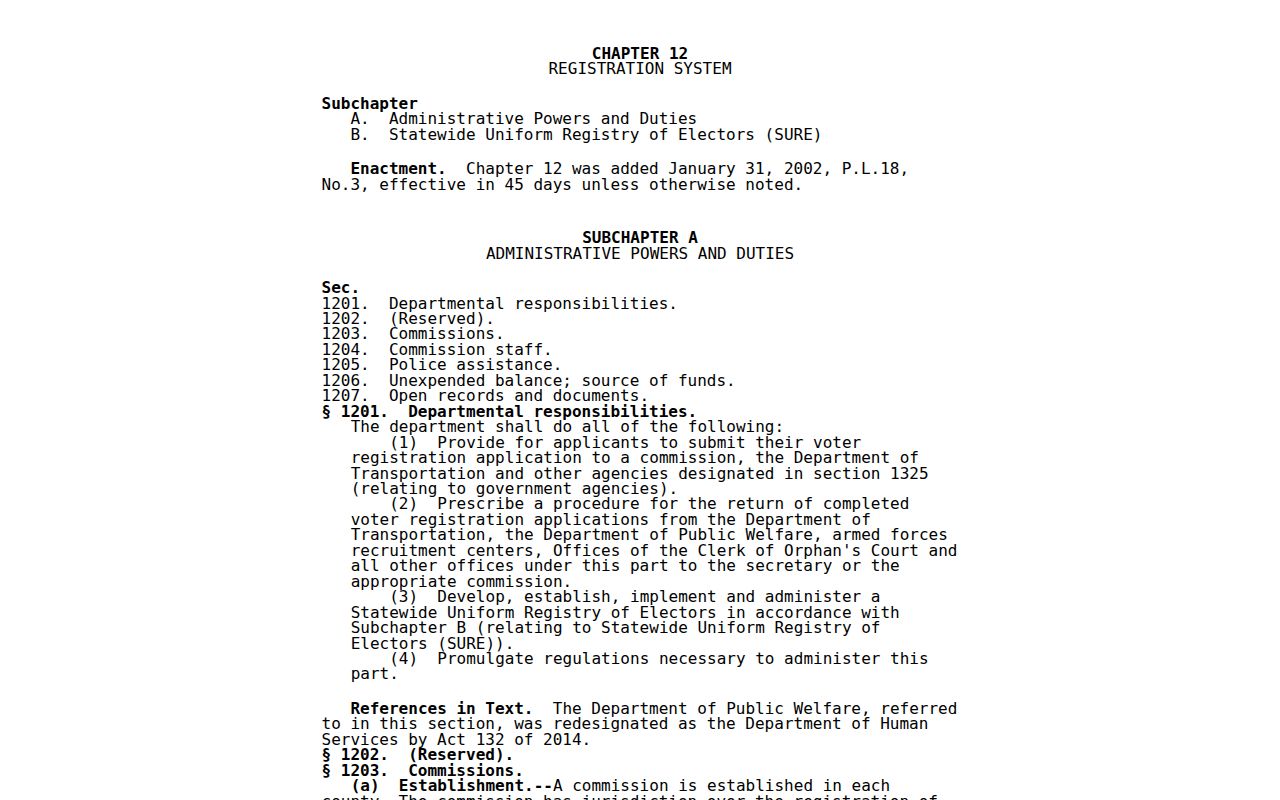
The statutory material belongs with the request and purpose limitation, not with a claim that election records can identify a block's households.
The Section 1404 record-access text is also preserved in the manifest.
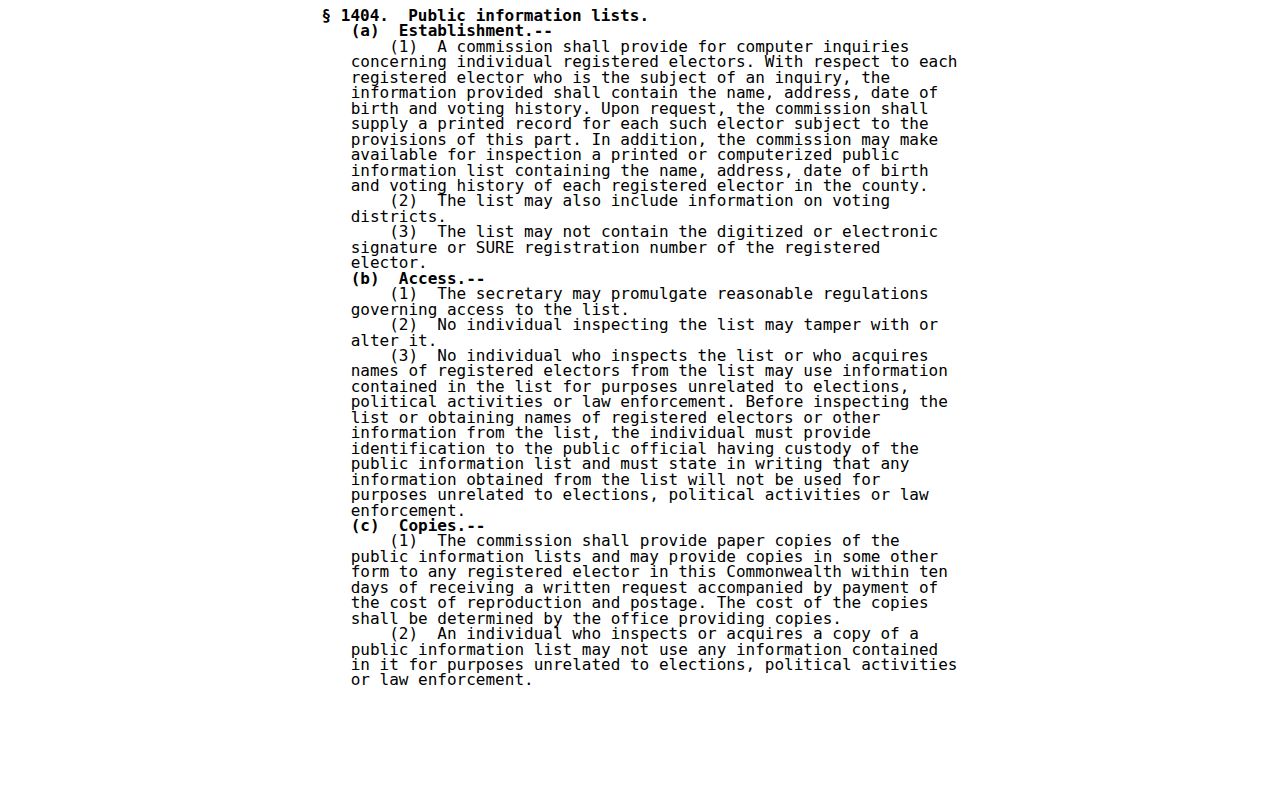
The section reinforces the identification, purpose, and handling rules that separate controlled election administration from a general neighbor lookup.
Springfield Township Neighbor Contacts
Springfield Township has a community layer, but it is a contact layer rather than a roster. Township navigation lists civic, recreational, and service organizations such as the Lions Club, Junior Women's Club, Garden Club, Friends of Smedley Park, Conservation Committee, American Legion, AAUW, League of Women Voters, athletic and youth groups, and scouts. These organizations can be useful places to ask about public events or civic participation. Their public listing does not prove that a person lives at a particular property or belongs to the group.
| Contact channel | What is verified | What is not established |
|---|---|---|
| Township community navigation | Official links to named civic and service groups | Member names, home addresses, or parcel coverage |
| Community Watch | An application returned to the police station | A public watch roster or block membership list |
| Lions and Junior Women's Club | Local organization history and meeting contact context | Evidence that any particular resident belongs |
| Friends of Smedley Park and civic groups | Public community-contact route | Neighborhood boundaries or household directory |
The Springfield Township community contacts are the appropriate source for these organizations. No verified public HOA, neighborhood-association, watcher, alumni, or volunteer roster was found. Treat an organization name as an invitation to use the official contact path, not as evidence about Springfield Township neighbors.
Note: A listed civic group is a public contact route, not evidence of membership, residence, property coverage, or a person-to-parcel connection.
Springfield Township Neighbor Safety Boundaries
Public-safety records have their own limited purpose. Pennsylvania State Police Megan's Law information is a public-protection resource with a terms acceptance step, ZIP and radius search routes, and a warning against threats, intimidation, harassment, or misuse. It should not be used to label an entire block, infer facts about people at an adjoining address, or stand in for ordinary neighbor information. Registry information is limited to what the state posts and may not be complete or current.
The Pennsylvania State Police Megan's Law landing page shown in the manifest introduces that limited public-protection scope.
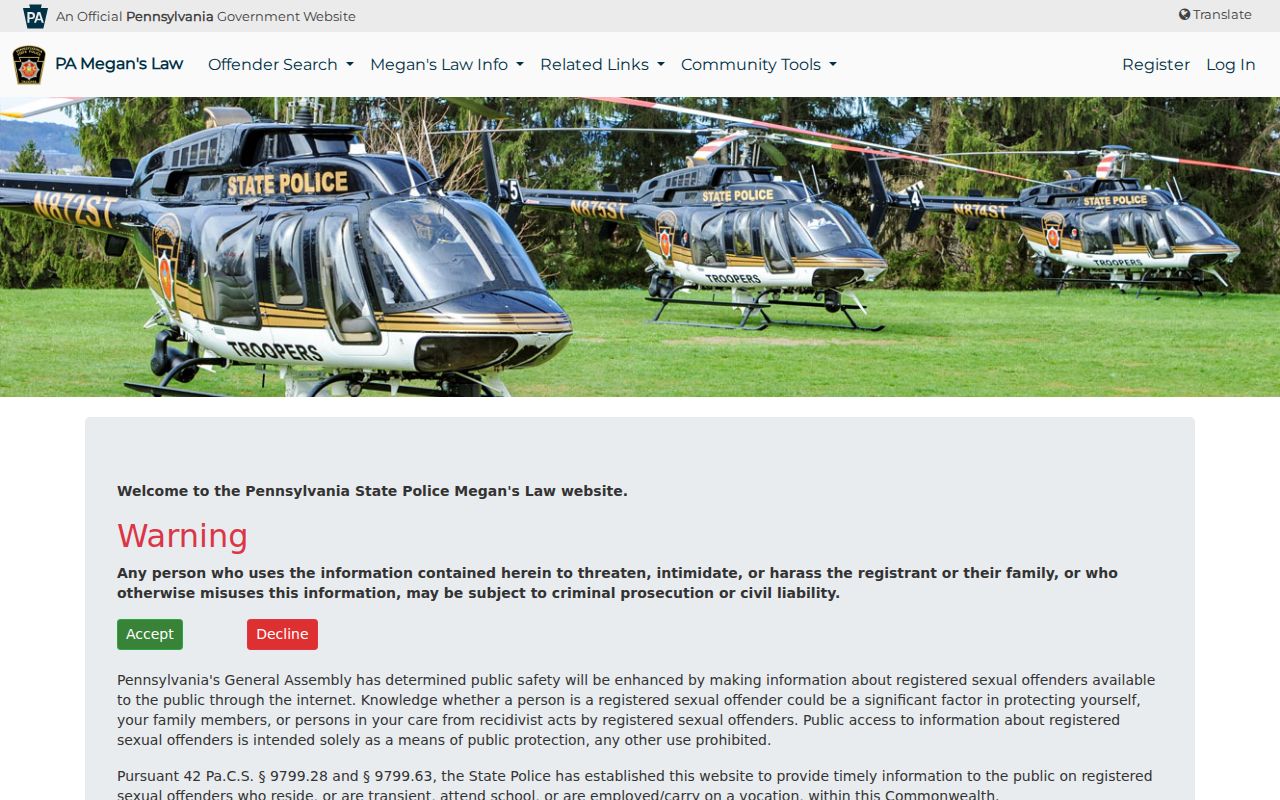
The proper use of the state registry remains public safety under its stated terms, not a method for building a block roster.
The Megan's Law public-search FAQ explains the available public information and misuse warning.
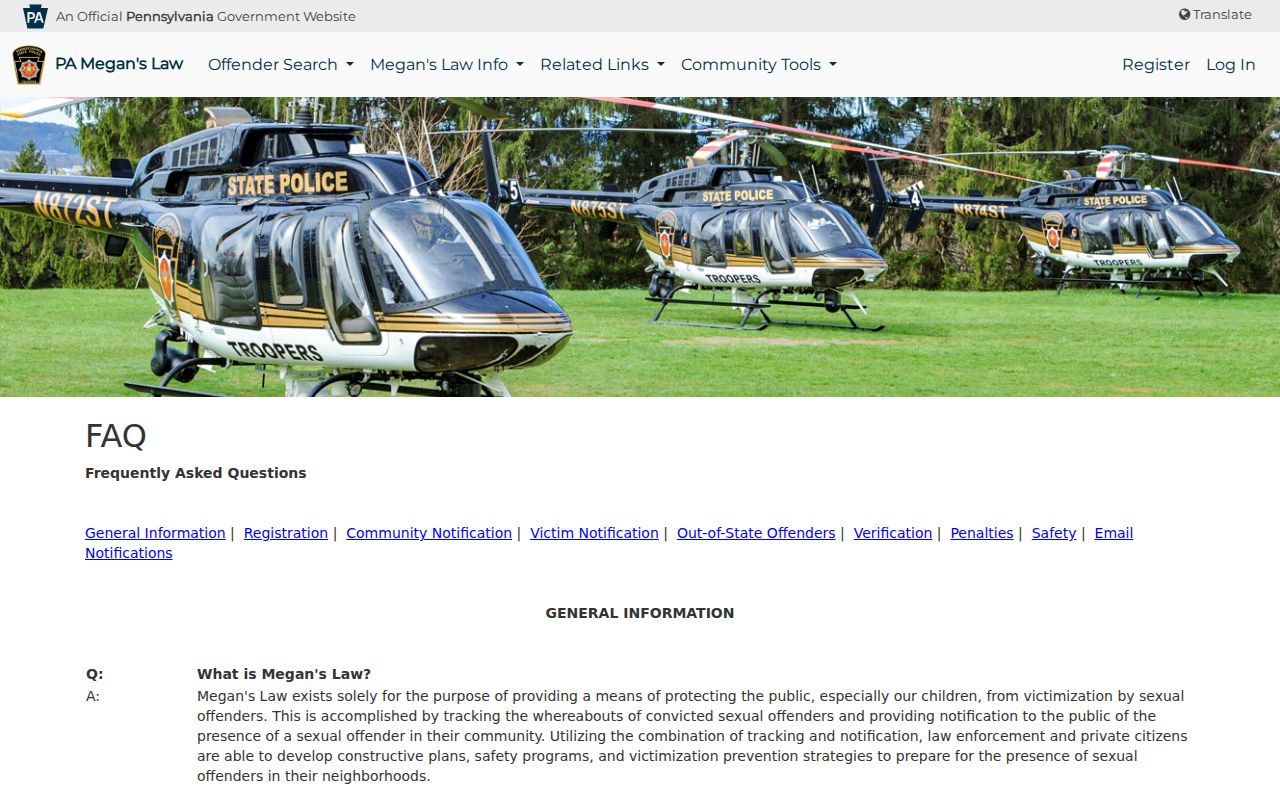
For a geographic safety feature, the official ZIP and radius search is the state-provided route.
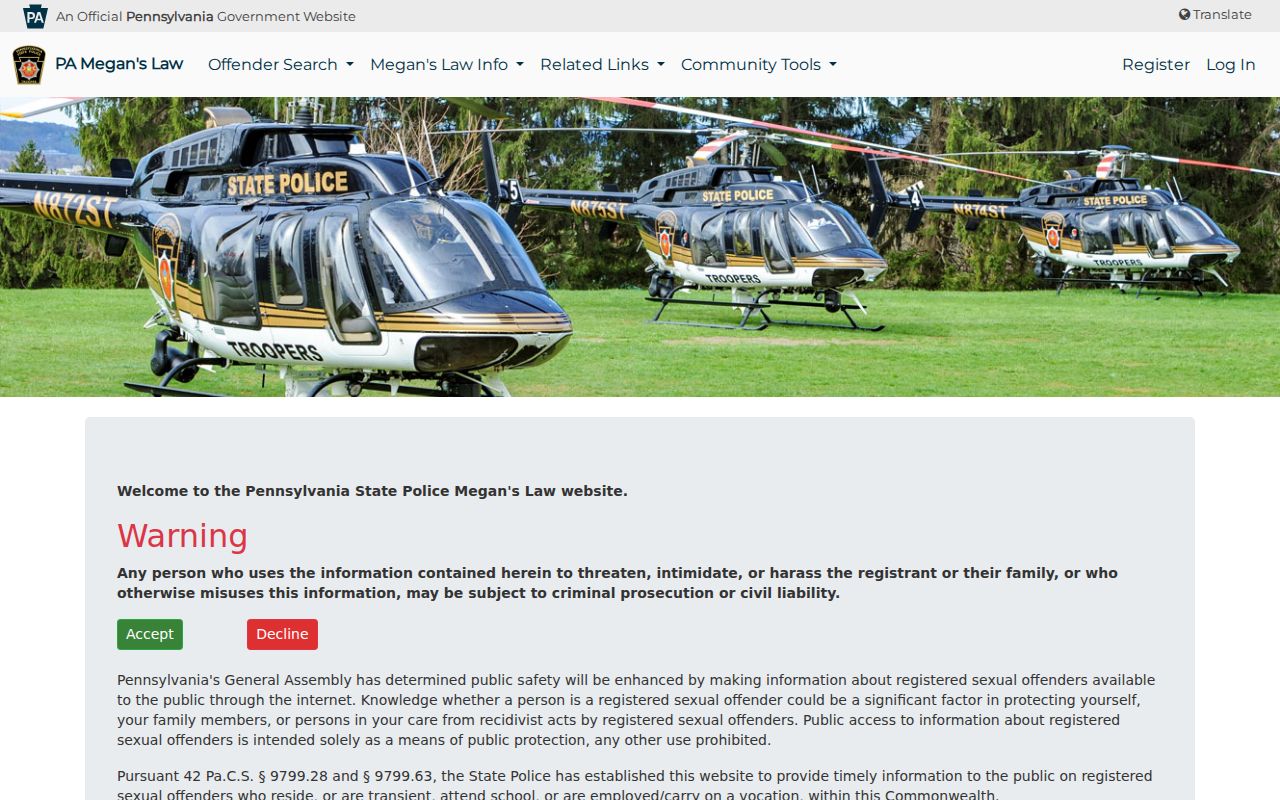
A ZIP or radius result tracks the registry's posted information only. It does not identify every person in an area or prove a relationship to a particular parcel.
Springfield Township Neighbor Privacy Controls
Pennsylvania privacy limits are custodian-specific. The Address Confidentiality Program gives qualifying survivors a substitute address for a range of court, government, voter, credential, marriage, school, and utility records. A missing or substitute address can be a safety feature, and there is no legitimate workaround. RTKL also protects personal identifiers and directs agencies to redact exempt information while releasing reasonably segregable public material. Utility, delivery, driver, and private household data are not a block-search channel.
| Official record trail | Commercial neighbor tools |
|---|---|
| Shows the limited record held by a named custodian and the record's date or role. | May combine public fragments but can be delayed, incomplete, or mismatched. |
| Uses parcel, Recorder, election, or safety rules specific to the source. | Does not override safety protections or turn a parcel into a household record. |
| Can be checked against the original office when a fact matters. | Should not be treated as official evidence of residence or identity. |
For a record correction or a question about redaction, contact the office that created the record. Pennsylvania does not offer a single statewide removal request for all public and private databases. The appropriate response depends on whether the information is held by the Recorder, a court, elections, the Township, or a private service.
Limits on a Neighbor Lookup
Springfield Township neighbors can be researched responsibly only through the narrow question each record can answer. A map shows adjacency. A Recorder document shows a recorded party. A controlled election list is governed by a signed, limited-purpose rule. Community groups are contacts, not memberships. A current occupant may be absent from every property record. When the needed fact is private, incomplete, sealed, or protected, the correct result is to stop rather than fill the gap with an assumption.
Lawful use. Use block and property information for personal, lawful research and public-safety awareness only. Pennsylvania law prohibits stalking and harassment, and public records never permit intimidation, repeated unwanted contact, or harm.